
The menopause and post-menopause are when huge changes happen in a woman’s body and all sorts of issues can arise.
Depression, anxiety and insomnia become common as does bone loss. Joints get creaky and can flare up. Oh yes, it’s a bag load of fun!
Inflamed joints however, can be down to two very different conditions, so how to tell them apart?
Shabir Daya, pharmacist at Victoria Health, explains the difference and recommends some helpful supplements.
Arthritis is a general term for numerous conditions that damage joints.
The term arthritis simply means inflammation of the joint. Osteoarthritis (OA), the most common form of arthritis, is thought to affect approximately 10 million people in the UK which equates to one in ten adults in the country.1 Rheumatoid arthritis (RA), though less common, is different in its causes and its treatment to a degree. Both osteoarthritis and rheumatoid arthritis cause joint pain, swelling, and stiffness. Both affect more women than men, and although there is not a cure, their progression can be slowed down by medications and/or supplements.
How can you tell if you have osteoarthritis or rheumatoid arthritis?
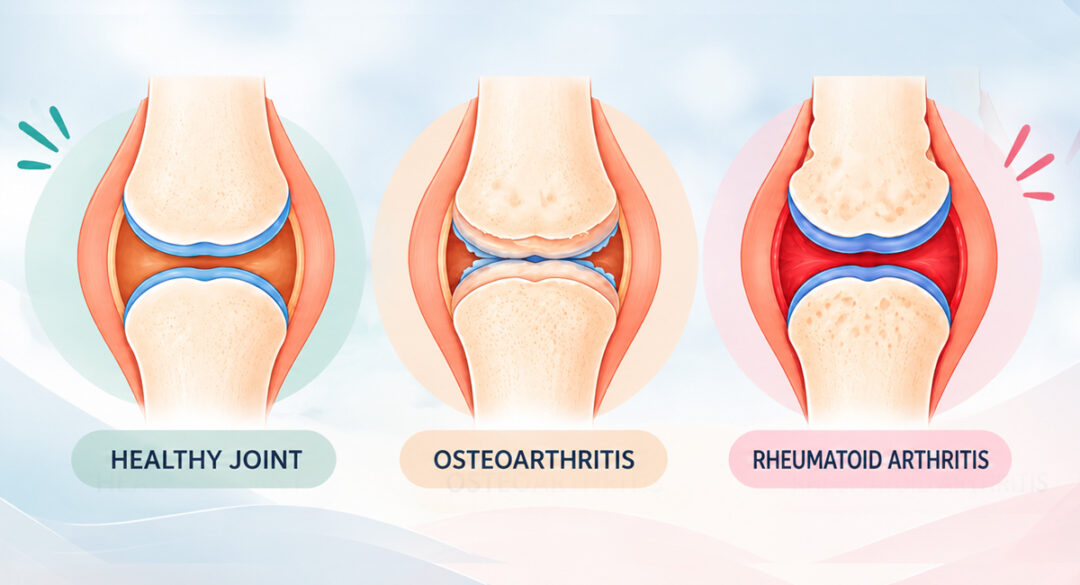
Osteoarthritis involves the wearing away of the cartilage in between bones in joints. Rheumatoid arthritis is a condition in which the immune system attacks the joints, beginning with the lining of the joints and the wearing away of the cartilage in between joints.2
The major differences are: OA develops slowly from cartilage breakdown in generally in weight bearing joints, whereas RA is the immune system attacking the joints rapidly with symmetrical joint inflammation. Osteoarthritis tends to be localised, so it may be a knee that is affected, whereas rheumatoid arthritis can often worsen in a matter of weeks.2
Morning stiffness that lasts briefly and improves upon movement is usually a symptom of osteoarthritis. Stiffness and pain that lasts over an hour, often accompanied by a lack of energy, are usually symptoms of rheumatoid arthritis.
Osteoarthritis tends to affect mostly the weight bearing joints such as knees, hips, and spine, usually asymmetrically, whereas rheumatoid arthritis tends to affect the small joints such as wrists and hands usually symmetrically.
Osteoarthritis tends to appear usually in the 60s, whereas rheumatoid arthritis tends to appear earlier anywhere between 30 and 60 years-of-age, although it can appear at any age.
Are there different tests to diagnose Osteoarthritis and Rheumatoid Arthritis?
Osteoarthritis is usually determined by clinical examination, whereas Rheumatoid Arthritis is determined by blood tests to detect the antibodies, physical examination as well as imaging.3
How to protect your joints naturally
Although the causes of OA and RA are different, the result is the same in that inflammation causes the destruction of the cartilage. Osteoarthritis is often regarded as a natural part of the ageing process but that is a simplistic view. Osteoarthritis is a degenerative disease in that there is a combination of factors, such as mechanical (wear and tear), inflammatory (compounds such as acids that cause inflammation) and metabolic (high sugar and fat levels promote inflammation) factors. One must address and act quickly otherwise the degeneration continues until movement is almost totally impaired if left untreated.
If you are overweight, then take steps to reduce weight
Shedding 5 Kilos reduces 20 Kilos of stress on the knees, as an example.
Manage your diet by cutting out oils such as sunflower and safflower, which contain linoleic acid, LA, which fuels inflammation. Switch to butter or ghee used in moderate amounts. It is important to move daily or undertake moderate exercise, as this helps to reduce stiffness by improving circulation to eliminate the compounds that cause pain and stiffness. Exercise also helps metabolic activity and strengthens the muscles that stabilise joints.
Consider taking a supplement such as Superior Joints. This supplement for joint pain and care contains Natural Eggshell Membrane which has been part of the review by the NIH concluding that it helps to alleviate joint and muscle pain rapidly. This Natural Eggshell Membrane supplement also contains hydroxyproline, naturally occurring glucosamine and other amino acids that are known to help stabilise cartilage when taken on a long-term basis. In addition, Superior Joints contains hyaluronic acid to cushion the cartilage matrix, cherry extracts to neutralise acids that cause pain and stiffness, ginger and a small amount of turmeric for their circulatory benefits in removing acids, and other vitamins known for their role in joint health. Superior Joints is also suitable for those with rheumatoid arthritis, as none of the ingredients stimulates the immune system.
Vitamin K2 plays an important role in joint health
It helps to prevent cartilage cell death and stopping inflammatory damage.4 Vitamin K2 enhances the production of proteins that may help prevent cartilage calcification and reduce systemic inflammation markers such as CRP. Many of us have a vitamin K2 deficiency, so one can increase dietary intake from sources such as aged cheeses, egg yolks, and from fermented foods such as sauerkraut and natto. Alternatively, you can take Life Extension Super K which provides two biologically active forms of K2, called MK7 and MK4. The combination of these two forms means the body has vitamin K2 for almost the entire day, as MK4 is rapid in action, but is also eliminated easily, whilst MK7 works slower but it is available for a longer period of time.
Do not ignore the early signs of osteoarthritis or rheumatoid arthritis, as early treatment prevents permanent joint damage.
References:
- Prevalence | Background Information | Osteoarthritis – NICE CKS
- Source: Mayo Clinic: https://www.mayoclinic.org/diseases-conditions/arthritis/multimedia/osteoarthritis-vs-rheumatoid-arthritis/img-20008728
- https://www.nhs.uk/conditions/rheumatoid-arthritis/diagnosis/
- https://pmc.ncbi.nlm.nih.gov/articles/PMC11396581/
Disclaimer
The views, opinions and information expressed in this article are those of the author(s) in an editorial context. Agelessbyglynisbarber.com cannot be held responsible for any errors or for any consequences arising from the use of the information contained in this editorial or anywhere else on the site. Every effort is made to see that no inaccurate or misleading information, opinion or statement appear, nor replace or constitute endorsement from medical bodies or trials unless specified. Agelessbyglynisbarber.com accepts no liability for the consequences of any inaccurate or misleading data, information, opinion or statement. Information in the editorials is provided for informational purposes only and is not intended as a substitute for the advice provided by your physician or other healthcare professional. You should not use the information on this website or in the editorials for diagnosing or treating a health concern or disease, or for the replacement of prescription medication or other treatment.

